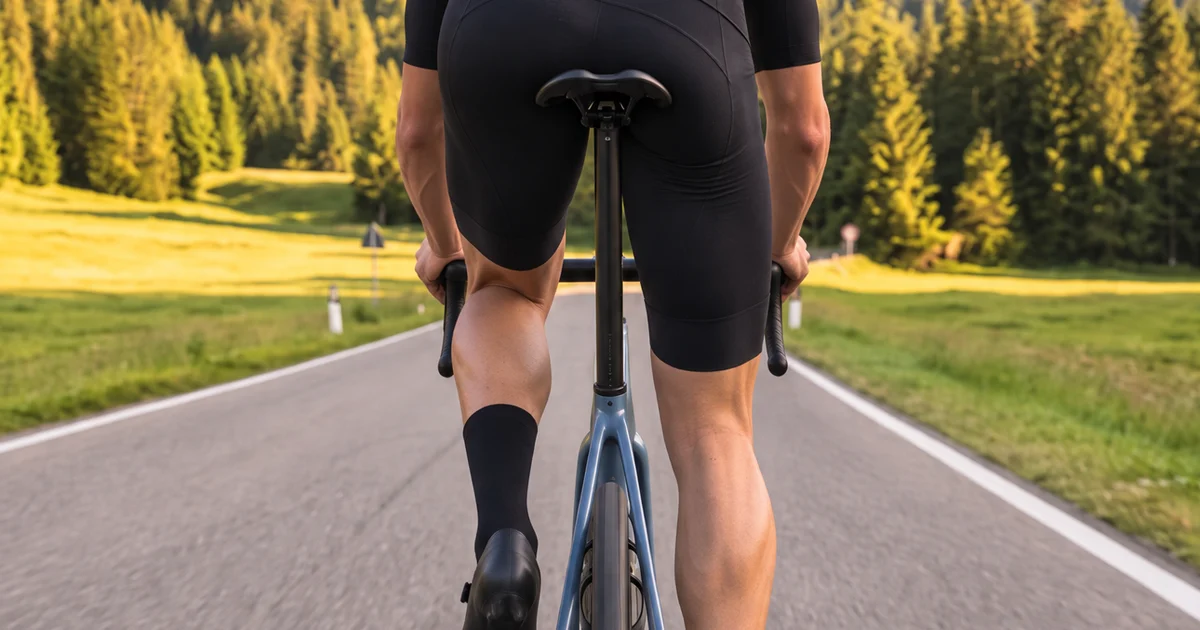
Your saddle is probably too high if your hips rock side to side, your toes point down to reach the bottom of the stroke, or you feel strain behind the knee. It is probably too low if your knee rises high at the top of the stroke, your thighs burn early on easy rides and the front of your knee aches.
Those signs tell you which way to look. One measurement settles it: how bent your knee is at the bottom of the pedal stroke.
A quick self-test
Pedal on a trainer at an easy pace and watch for these four things. Ask a friend to film you from behind and from the side, or use a mirror.
- Do your hips rock? If your pelvis drops side to side with each stroke, your legs are running out of length at the bottom and your hips are reaching for the pedal. That means the saddle is too high (here is what hips rocking on the saddle looks like).
- Do your toes point down at the bottom? A high saddle makes you point your toes to keep contact with the pedal. It feels normal after a while, which is why it hides so well. Pointing the foot down lets the knee bend more than it otherwise would, so a high saddle can look fine on a quick glance while your ankle does the compensating1.
- Do you creep onto the nose? Riders often slide forward to shorten the distance to the pedals. If you keep shuffling back, height is a suspect.
- Does your knee stay bent and rise high? At the top of the stroke your thigh climbs close to your chest and you feel cramped on hard efforts. A low saddle keeps the knee deeply bent through the stroke, so even easy riding loads the front of your thighs, and standing on climbs feels like relief because seated you can't extend the leg properly.
Too high vs too low
| Saddle too high | Saddle too low | |
|---|---|---|
| What you notice | Hips rock, toes point down, you slide forward | Knee rises high and feels cramped, quads burn early on easy rides, you feel stuck on climbs |
| Where it hurts | Behind the knee, in the hamstrings | Front of the knee |
| Next step | Measure your knee angle, then lower it a few millimetres | Measure your knee angle, then raise it a few millimetres |
Fitters commonly link pain at the back of the knee to a saddle that is too high. For the front of the knee, forces on the kneecap joint (patellofemoral compressive force) go up as the saddle goes down2. See three fit problems you can spot in seconds on Instagram.
Several of these signs can come from other things, like cleat position or a tight hamstring, so treat the table as a guide, not a diagnosis. If knee pain brought you here, read knee pain when cycling and saddle height.
Saddle height is set by your legs, specifically by the knee angle at the bottom of the pedal stroke, measured as how far the knee is bent from straight. A 2011 review of saddle-height research suggested a bend of 25-30° there, with the rider seated and the pedal at bottom dead centre, to reduce knee injury risk and oxygen cost2. Another study recommended 25-35° for both trained and untrained cyclists3.
Those numbers come from a static check: you sit still, the crank is at the bottom, someone measures. When you pedal, the angle changes. Work on well-trained cyclists treated 30-40° as the optimal knee flexion measured during pedalling4, and a study comparing measurement methods found dynamic knee angles substantially different from the static measure5. A 2022 systematic review found strong evidence that saddle height should be set using dynamic measurements of the knee angle, taken while you ride6. The same comparison found that 2D kinematics, angles measured in the side view, is a valid tool for knee-angle assessment during bike fitting5. Checking your bike fit with a phone video does exactly that.
Why the heel method and the 109% rule only get you close
The two shortcuts passed around every group ride are fine for a first setup. Neither is a fit.
The heel method. Sit on the bike, put your heel on the pedal with the crank in line with the seat tube, and raise the saddle until your leg is fully straight2. When you clip in on the ball of your foot, the knee will bend. The method ignores your foot length, shoe and cleat stack, and how you move your ankle. The 2011 review noted that methods based on leg length don't account for individual differences in thigh, shin and foot length2.
109% of inseam. Measure your inseam, multiply by 1.09, and set the distance from the pedal axle to the top of the saddle to that number. It comes from early lab work on time to exhaustion2. When researchers checked where it put the knee, the 109% setting fell outside the 25-35° range 63% of the time3. In a group of well-trained cyclists, 56.5% rode with a saddle height outside the 106-109% inseam range, yet only 26% had a knee angle that was off when measured while pedalling4. A percentage of inseam and a good knee angle are not the same thing.
Use either method to get close on a new bike, then measure.
Saddle height is about your legs, nothing else. If you feel stretched out, your back aches or your neck is tired, don't move the saddle to fix it. Those are cockpit problems: stem length, bar height, spacers and bar reach.
Change it in small steps
- Mark your current height. A strip of tape on the seatpost at the clamp, or a measurement from the centre of the bottom bracket to the top of the saddle. You want a way back.
- Move a few millimetres. Not a centimetre. A 2022 review found that changes under 4% of leg length had only trivial to small effects on loads through the leg6, and small steps keep you well inside that.
- Change one thing. Don't move the saddle and swap cleats on the same day, so you know why something got better or worse.
- Ride it a few times. Give each change several rides before you judge it.
- Check again. Re-measure the knee angle after the change, so you know where you ended up rather than guessing.
- Stop if it hurts. Pain is not a sign you need one more adjustment.
Pain, injury, numbness or a marked difference between your left and right side should be assessed by a qualified professional, such as a physiotherapist or an in-person bike fitter. A video check or a saddle tweak does not replace that.
Confirm it on video
The TrainCraft video check measures your knee angle while you pedal, which is the measurement the research points to. The setup for the clip is in how to film your bike fit video.
It also measures your back and elbow angles and compares all three with the typical range for the bike, size and riding style you pick. For saddle height, it tells you whether your knee angle sits in range and, if not, whether to move the saddle up or down. If your back or elbow angle is off, it points you to the bar instead, so you don't chase a reach problem with the saddle.
Your video never leaves your phone; only joint coordinates are sent.
The free first check settles the question this article asks: too high, too low or fine. The paid fit report turns the direction into millimetres and allows unlimited re-checks after each small saddle move. If a new frame is the next step, the bike fit calculator suggests a size.
Check your saddle height on video
FAQ
How do I know if my saddle is too high or too low without tools?
Run the self-test above. Rocking hips and toes pointing down at the bottom of the stroke suggest too high, while a knee that rises high and burning quads suggest too low. These point you in a direction, but only a knee-angle measurement tells you how far off you are.
What knee angle should I aim for?
Static checks, done sitting still with the pedal at the bottom, usually aim for about 25-35° of knee bend23. Measured while pedalling, the angle reads differently, and one study treated 30-40° as optimal for well-trained cyclists4. Compare your number with a range measured the same way.
Is the heel method accurate enough to set saddle height?
It is fine for a first setup, but it ignores your foot length, shoe and cleat stack, and how you move your ankle2. Use it to get close on a new bike, then measure your knee angle.
How much should I move my saddle at a time?
A few millimetres. Change one thing, ride several times, then check again before the next step.
Last reviewed: November 2026. Written by the TrainCraft team.
Footnotes
-
Bini, R. R., Tamborindeguy, A. C., & Mota, C. B. (2010). Effects of saddle height, pedaling cadence, and workload on joint kinetics and kinematics during cycling. Journal of Sport Rehabilitation, 19(3), 301-314. https://doi.org/10.1123/jsr.19.3.301 ↩
-
Bini, R., et al. (2011). Effects of bicycle saddle height on knee injury risk and cycling performance. Sports Medicine, 41(6), 463-476. https://doi.org/10.2165/11588740-000000000-00000 ↩ ↩2 ↩3 ↩4 ↩5 ↩6 ↩7
-
Peveler, W. W., et al. (2007). Effects of saddle height on anaerobic power production in cycling. Journal of Strength and Conditioning Research, 21(4), 1023-1027. https://doi.org/10.1519/R-20316.1 ↩ ↩2 ↩3
-
Ferrer-Roca, V., et al. (2012). Influence of saddle height on lower limb kinematics in well-trained cyclists: static vs. dynamic evaluation in bike fitting. Journal of Strength and Conditioning Research, 26(11), 3025-3029. https://doi.org/10.1519/JSC.0b013e318245c09d ↩ ↩2 ↩3
-
Fonda, B., et al. (2014). Validity and reliability of different kinematics methods used for bike fitting. Journal of Sports Sciences, 32(10), 940-946. https://doi.org/10.1080/02640414.2013.868919 ↩ ↩2
-
Bini, R., & Priego-Quesada, J. (2022). Methods to determine saddle height in cycling and implications of changes in saddle height in performance and injury risk: a systematic review. Journal of Sports Sciences, 40(4), 386-400. https://doi.org/10.1080/02640414.2021.1994727 ↩ ↩2