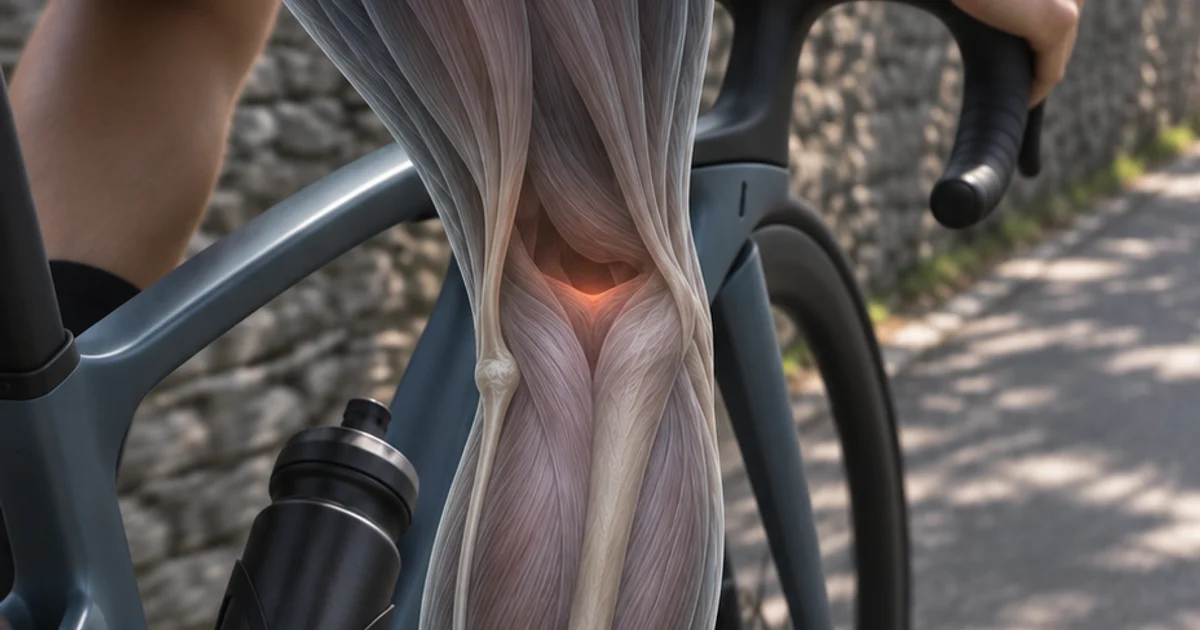
Saddle height is one of the most common fit-related causes of knee pain when cycling: a saddle that's too low tends to load the front of the knee, and one that's too high tends to stress the back and outside. The fix starts with one number, your knee angle at the bottom of the pedal stroke.
Saddle height isn't the only possible cause. A review of saddle height research puts overuse knee pain at about 50% of cyclists1. In a study of 109 professional road cyclists, 36% reported anterior knee pain in the previous 12 months, and the knee made up 23% of all overuse injuries recorded. Knee injuries were also the ones most likely to cost riders time off the bike2. At 90 rpm you turn the pedals 5,400 times an hour, so a small error in position adds up.
Pain at the front of the knee
A low saddle keeps your knee more bent through the whole stroke. More bend under load means more pressure between the kneecap and the thigh bone, and one review describes patellofemoral compressive force as inversely related to saddle height1. That is the classic ache around or under the kneecap after a ride.
To see whether the saddle is the cause, check your knee angle at the bottom of the stroke first (the reel on three settings to check for front knee pain shows how).
Pain behind the knee
A high saddle makes your leg reach for the pedal at the bottom, and the hamstring tendons behind the knee stretch with every stroke. Biceps femoris tendinopathy has been linked to an excessively high saddle or tight hamstrings3. Hips rocking side to side on the saddle are another sign it's too high (here are three things to check for pain behind the knee).
Pain on the outside of the knee
Iliotibial band syndrome has been linked to a saddle that's too high3. Other factors, such as cleat setup, can play a role too, so the saddle is one suspect among several. Our video on pain on the outside of the knee covers what to check.
Pain on the inside of the knee
Inside-knee pain isn't covered by the research in this article. The reel on pain on the inside of the knee shows what to check.
The evidence linking saddle height directly to injury is limited1, and one systematic review found no significant change in patellofemoral forces with saddle position in the studies it included3. Treat pain location as a list of usual suspects, not a verdict.
Persistent pain, swelling, a knee that locks or gives way, numbness, or pain that's clearly worse on one side needs a qualified professional: a sports physician, physiotherapist or experienced bike fitter. A bike fit check doesn't replace that assessment.
The knee angle, and why formulas miss it
Saddle height is set by your legs, specifically by how much your knee is still bent when the pedal reaches the bottom of the stroke. Too much bend means the saddle is low. Too little bend, or a leg that snaps straight, means it's high. How to tell if your saddle is too high or too low lists the signs to look for.
A review of saddle height research suggests a knee flexion angle of 25-30°1. A study that filmed well-trained cyclists while they pedalled used an optimal range of 30-40°4. The gap is partly method: one measurement is taken with the rider stopped and the pedal parked at the bottom, the other from video while the rider pedals. A study comparing the approaches found the dynamic methods differed substantially from the static one5, so check whether a number came from a still rider or a moving one.
Percentage-of-inseam formulas don't settle it. In one study 56.5% of riders were outside the recommended 106-109% of inseam range, and 26% had an inappropriate knee angle when measured on video. The authors concluded that the inseam range may not guarantee an optimal knee angle4. You can check your bike fit with a phone video to measure the angle itself.
Small changes matter: a 5% change in saddle height changed knee joint kinematics by about 35% and knee moments by about 16%1. If your angle is clearly outside the range:
- Put a strip of tape on the seatpost at the frame so you can go back.
- Change one thing at a time. Don't move the saddle and swap cleats in the same week.
- Move a few millimetres per adjustment.
- Ride several sessions before judging a change.
- Re-check the angle after each change instead of going by feel.
- Stop if pain gets worse. Fit changes should ease symptoms over time, not sharpen them. If they don't, get a professional assessment.
Saddle height is a leg setting, not a comfort dial. If your back aches, your neck is stiff, or you feel stretched out to the bars, moving the saddle only pushes your knees out of their range and swaps one problem for another. Reach, back and neck problems are fixed at the cockpit: stem length, bar height, spacers and bar reach. If the cockpit can't fix it because the frame is the wrong size, the bike fit calculator recommends a size. Leave the saddle where your legs need it.
Check the angle on your own bike
The TrainCraft video check turns a short phone video into your knee angle at the bottom of the stroke, plus your back and elbow angles. Each is compared with the typical range for the bike, size and riding style you pick, and you are told which part of the bike to move, saddle or bar, and in which direction.
The clip is filmed from the side on a trainer, and how to film your bike fit video has the setup. Your video never leaves your phone; only joint coordinates are sent.
The first check costs nothing and shows whether your knee angle is in range. The paid fit report gives millimetres for your bike and unlimited re-checks, so each saddle change is confirmed against the angle.
Check your knee angle on video
FAQ
Can a saddle that's too low cause knee pain?
It can. A low saddle keeps your knee more bent under load, and patellofemoral compressive force tends to rise as saddle height drops1. That typically shows up as pain at the front of the knee, around the kneecap.
Does a saddle that's too high hurt the back of the knee?
It's a common link. An excessively high saddle has been associated with pain from the hamstring tendon behind the knee, and with iliotibial band pain on the outside3.
What knee angle should I aim for?
A widely cited review suggests 25-30° of knee flexion at the bottom of the stroke1, while a study using video of riders pedalling used 30-40°4. Static and dynamic measurements give different numbers5, so compare like with like.
Should I lower my saddle if my back hurts?
No. Saddle height is set by your legs, and moving it for your back puts your knees in the wrong place. Fix reach and back discomfort at the cockpit with stem length, bar height, spacers or bar reach, and see a professional if the pain persists.
Last reviewed: November 2026. Written by the TrainCraft team.
Footnotes
-
Bini, R., Hume, P. A., & Croft, J. L. (2011). Effects of bicycle saddle height on knee injury risk and cycling performance. Sports Medicine, 41(6), 463-476. https://doi.org/10.2165/11588740-000000000-00000 ↩ ↩2 ↩3 ↩4 ↩5 ↩6 ↩7
-
Clarsen, B., Krosshaug, T., & Bahr, R. (2010). Overuse injuries in professional road cyclists. American Journal of Sports Medicine, 38(12), 2494-2501. https://doi.org/10.1177/0363546510376816 ↩
-
Johnston, T. E., Baskins, T. A., Koppel, R. V., Oliver, S. A., Stieber, D. J., & Hoglund, L. T. (2017). The influence of extrinsic factors on knee biomechanics during cycling: a systematic review of the literature. International Journal of Sports Physical Therapy, 12(7), 1023-1033. https://doi.org/10.26603/ijspt20171023 ↩ ↩2 ↩3 ↩4
-
Ferrer-Roca, V., Roig, A., Galilea, P., & García-López, J. (2012). Influence of saddle height on lower limb kinematics in well-trained cyclists: static vs. dynamic evaluation in bike fitting. Journal of Strength and Conditioning Research, 26(11), 3025-3029. https://doi.org/10.1519/JSC.0b013e318245c09d ↩ ↩2 ↩3
-
Fonda, B., Sarabon, N., & Li, F.-X. (2014). Validity and reliability of different kinematics methods used for bike fitting. Journal of Sports Sciences, 32(10), 940-946. https://doi.org/10.1080/02640414.2013.868919 ↩ ↩2