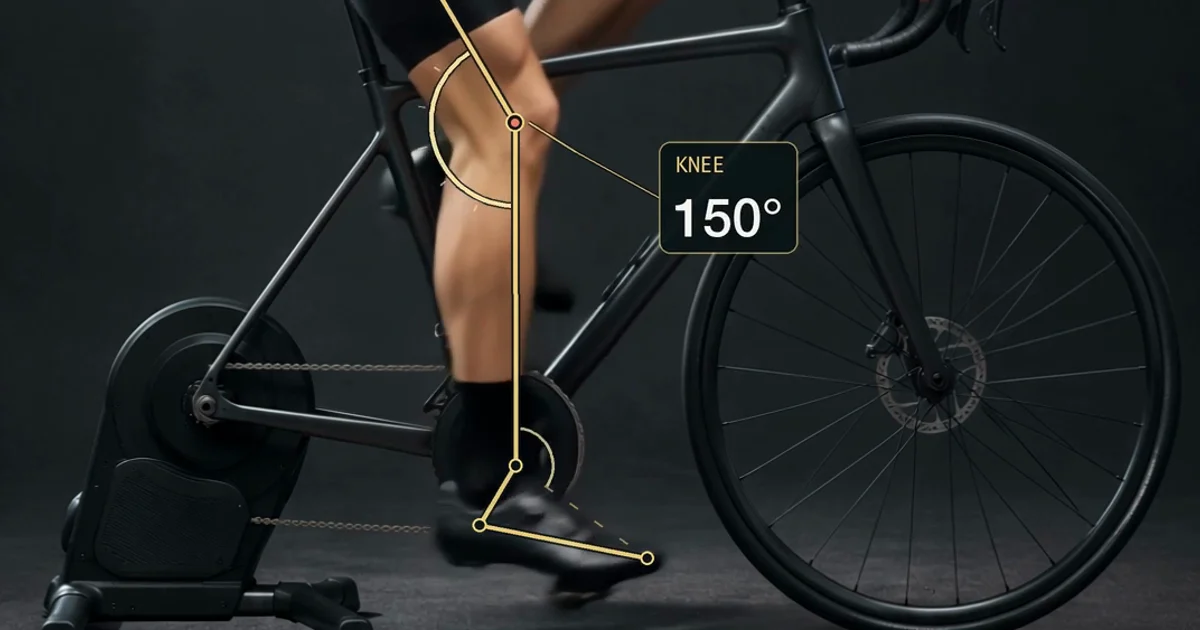
You can check your bike fit with a phone video by filming yourself from the side while you pedal on a trainer, then measuring your knee angle at the bottom of the pedal stroke. That one angle tells you whether your saddle is too high, too low or about right (how to tell if your saddle is too high or too low).
For how far a camera gets you compared with a studio, see bike fit at home and what a camera can see.
What exactly gets measured
The angle is measured at the bottom of the pedal stroke, where the leg is at its longest. Fitters call this bottom dead centre. The point of maximum extension doesn't always fall exactly at 6 o'clock, so look at the most extended frame in each stroke, not at a fixed crank position.
The points are the hip, the knee and the ankle. The angle between the hip-to-knee line and the knee-to-ankle line is the knee angle.
Fitters usually express it as knee flexion: how far the leg is from perfectly straight. A straight leg is 0° of flexion. A bent leg is 30°, 40° and so on. Too little flexion means the leg is nearly locked out at the bottom. The saddle is likely too high, and your hips may rock side to side as you reach for the pedal. Too much flexion means the knee stays cramped, and the saddle is likely too low.
The knee is the right thing to measure because small saddle changes show up there clearly. A review of saddle height research found that a 5% change in saddle height was linked to roughly a 35% change in knee joint movement1.
Saddle height is set by your legs, and only your legs. If your back aches or you feel stretched out to the bars, don't move the saddle. Raising, lowering or sliding it to solve a reach problem breaks your leg position. Reach, back and neck issues are fixed at the cockpit: stem length, bar height, spacers and bar reach. If the frame itself is the wrong size, the bike fit calculator recommends one.
Measure it yourself in five steps
- Film 15-30 seconds from the side while you pedal steadily at 80-95 rpm on a trainer, with the phone set up as described below (main camera at 1x, bottom-bracket height, 2.5-3 m away).
- Scrub through the clip and pick the frame where your leg is most extended in one stroke.
- Mark three points on that frame: hip, knee and ankle.
- Draw a line from the hip to the knee and another from the knee to the ankle. The angle between them is your knee angle.
- Convert it to flexion: 180° minus the angle you measured. Fonda et al. found 2D read about 2.2° low against 3D and suggested adding 2.2° to a 2D reading for higher precision2.
Then compare the result with a range measured the same way (next section). If the video says your saddle is too low, raise it a few millimetres, ride a few times and film again. Change one thing at a time: if you change saddle height and stem on the same day, you won't know which one helped.
If you have knee pain, numbness, an injury, or one leg moves very differently from the other, don't fix it with a phone video. Get assessed by a qualified bike fitter or clinician. A video check doesn't replace an in-person fit.
Why your number may not match a chart
There are two ways to measure knee angle. A static measurement has you sit on the bike, stop the crank at the bottom and drop your heel while someone reads the angle with a goniometer. A dynamic measurement tracks your joints with a camera or motion system while you pedal normally.
The two don't give the same number. In a study that compared them on the same riders, all three dynamic methods differed substantially from the static measurement2. When you pedal, your ankle moves, your hips settle, and your heel doesn't sit in the dropped position you hold for a static check.
Published target ranges come from different methods. A widely cited review suggested 25-30° of knee flexion1. A study using dynamic 2D video analysis worked with 30-40° as its optimal range3. Neither is wrong. They measure different things, so compare a dynamic measurement with a dynamic range and a static measurement with a static range. Mixing them is how riders end up moving a saddle that was fine.
A systematic review of saddle height methods found strong evidence for setting saddle height from dynamic measurements of the knee angle4. Formulas based on inseam length are a starting point. In one group of well-trained cyclists, 56.5% rode with a saddle height outside the commonly recommended 106-109% of inseam3.
What can throw the angle off
A phone gives you a flat 2D view, while lab systems use several cameras to build a 3D model. In a comparison of 2D video with 3D motion capture for knee angle at the bottom of the stroke, researchers concluded that 2D kinematics is a valid tool for bike fitting, and the dynamic methods they tested were repeatable within a session2. Most bad readings come from the setup:
- A wide-angle lens (0.5x) bends straight lines near the edges of the frame. Use the main camera at 1x.
- A camera that is too high or too low shows the leg from above or below. Put the phone at bottom-bracket height.
- A camera at an angle to the bike causes parallax: the near and far legs shift, and limb lengths shrink unevenly. Even a modest tilt can move a reading from "fine" to "too low". Set the phone square to the bike.
- A camera too close turns small position changes into big perspective changes, and body parts fall out of frame. Stand it 2.5-3 m away with the whole rider and bike in frame.
- Baggy clothing hides where the hip, knee and ankle are. Wear fitted kit.
- Coasting or uneven pedalling leaves no consistent bottom of the stroke. Pedal steadily at 80-95 rpm.
Optional: matte markers of one bright colour, 15-20 mm, on your shoulder, elbow, wrist, hip, knee, ankle and the outside of your shoe make the joint points easier to find. The full setup is in how to film your bike fit video.
Or let the video check do it
The TrainCraft video check does the measuring for you. From a 15 to 30 second side-on clip it reads your knee, back and elbow angles and compares them with the typical range for the bike, size and riding style you pick. When the knee angle is outside that range, it says to move the saddle up or down; for back and elbow angles, it points you to the bar.
Your video never leaves your phone; only joint coordinates are sent.
You get the first check free, and it shows which direction to go. The paid fit report adds millimetres and unlimited re-checks, so each saddle change gets its own measurement.
Measure your knee angle on video
FAQ
Can I check my bike fit with just a phone?
Yes. Film yourself from the side on a trainer with the main camera at 1x, at bottom-bracket height and 2.5-3 m away. Research has found 2D video to be a valid way to measure knee angle for bike fitting2, as long as the camera setup is right.
What knee angle should I have at the bottom of the stroke?
It depends on how it's measured. A widely cited review suggested 25-30° of knee flexion1, while a dynamic video study used 30-40°3. Compare your number with a range measured the same way, and treat it as a range for your bike and riding style, not a single magic value.
Why does my static measurement disagree with my video?
When you pedal, your ankle and hips move in ways a stopped crank with a dropped heel doesn't capture. Studies have found dynamic and static knee angles differ substantially2, which is why dynamic measurement is the recommended way to set saddle height4.
How much should I move my saddle at a time?
A few millimetres. A 5% change in saddle height was linked to roughly a 35% change in knee joint movement1. Change one thing, ride a few times, then film again.
Last reviewed: November 2026. Written by the TrainCraft team.
Footnotes
-
Bini, R., Hume, P. A., & Croft, J. L. (2011). Effects of bicycle saddle height on knee injury risk and cycling performance. Sports Medicine, 41(6), 463-476. https://doi.org/10.2165/11588740-000000000-00000 ↩ ↩2 ↩3 ↩4
-
Fonda, B., Sarabon, N., & Li, F.-X. (2014). Validity and reliability of different kinematics methods used for bike fitting. Journal of Sports Sciences, 32(10), 940-946. https://doi.org/10.1080/02640414.2013.868919 ↩ ↩2 ↩3 ↩4 ↩5
-
Ferrer-Roca, V., Roig, A., Galilea, P., & García-López, J. (2012). Influence of saddle height on lower limb kinematics in well-trained cyclists: static vs. dynamic evaluation in bike fitting. Journal of Strength and Conditioning Research, 26(11), 3025-3029. https://doi.org/10.1519/JSC.0b013e318245c09d ↩ ↩2 ↩3
-
Bini, R. R., & Priego-Quesada, J. I. (2022). Methods to determine saddle height in cycling and implications of changes in saddle height in performance and injury risk: A systematic review. Journal of Sports Sciences, 40(4), 386-400. https://doi.org/10.1080/02640414.2021.1994727 ↩ ↩2