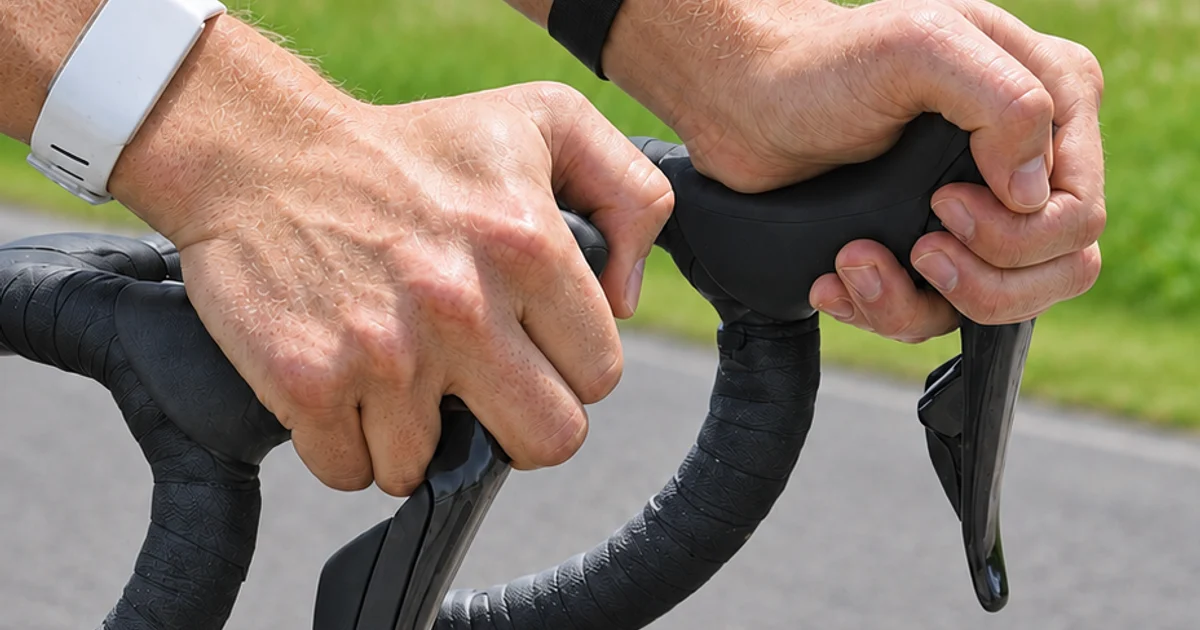
Numb hands while cycling usually come from pressure on the ulnar or median nerve where it crosses your palm and wrist, because too much of your weight sits on the bar. The most common fit cause is a cockpit that is too long or too low, which locks your elbows, bends your wrists back and turns your hands into the main support for your upper body. It is one of the most fixable fit problems, and the fix almost always lives at the front of the bike, not under your seat.
Which fingers go numb tells you which nerve
The ulnar nerve runs along the outside of your palm into the ring and little fingers. It passes through a narrow tunnel at the wrist (Guyon's canal), right under the fleshy heel of your hand that presses on the bar. When it gets compressed, cyclists call it handlebar palsy or cyclist's palsy1.
The median nerve runs through the carpal tunnel into the thumb, index and middle fingers. It gets irritated when your wrist stays bent back for hours with weight on it.
Long rides make both common. In a prospective study of 25 riders on a 600 km ride, 23 had motor symptoms, sensory symptoms or both by the end2. In a survey of 518 recreational cyclists, 31.1% reported overuse complaints in their hands, the fourth most common site after the neck, knees and groin3.
Weakness is the quieter version of numbness. Nerve tests on 14 riders before and after a 6-day, 420-mile tour found that the deep motor branch of the ulnar nerve conducted more slowly after the ride, and carpal tunnel symptoms got worse in 3 hands1. Some riders compress only that motor branch and lose grip strength or finger coordination with no numbness at all, so they don't notice until the damage is significant4.
What presses on the nerve
On a well-fitted bike, your core and a slight bend in your arms share the load, and your hands mostly steer. On a badly fitted bike, your hands become the third contact point that takes the hit.
- Reach that is too long: you stretch for the bar, your elbows straighten, your shoulders lock, and your weight falls onto the heels of your hands with nothing to absorb road buzz.
- Bar drop that is too big: a bar set far below the saddle tips your torso forward, and the lower your chest, the more of your body weight moves toward the front wheel and into your palms.
- Locked elbows: straight arms turn every bump into a direct hit on the nerve, while a soft bend works like suspension and lets your shoulders and core share the work.
- Bent-back wrists: when the bar is low or far, your wrists extend to keep your palms on the hoods or tops, which loads both nerves at once. A pressure-mapping study of 36 experienced cyclists found that the drops produced the highest pressure over the ulnar nerve area and the most extended wrist of the three hand positions tested5.
- One position for hours: pressure plus time is what hurts the nerve, so even a good position becomes a bad one if you never move your hands.
See the three checks for numb hands on Instagram.
Do not fix a reach problem by moving your saddle. Saddle height is set by your legs, by the knee angle at the bottom of the pedal stroke. Sliding the saddle forward or dropping it to get closer to the bar trades numb hands for knee or hip trouble. Reach is fixed at the cockpit.
What to change, cheapest first
Change one thing at a time and ride a few times before judging. First check the saddle, by the legs only: its height should suit your knee angle at the bottom of the stroke (how to tell if your saddle is too high or too low). Then leave it alone.
Habits cost nothing, but they handle what is left after the fit; if your elbows lock on the hoods, go straight to the cockpit.
- Relax your grip. Squeezing the bar adds pressure you don't need. If you can wiggle your fingers on the hoods, your grip is loose enough.
- Keep your wrists straight, so your forearm and the back of your hand form a line instead of letting the wrist sag or bend back.
- Move your hands often. Rotate between the tops, the hoods and the drops every few minutes. The authors of the pressure study concluded that changing hand position cuts both how hard and how long the nerve is loaded5. The 600 km study made the same recommendation alongside gloves and proper bike fit2.
- Use your core. Light tension through your torso holds your upper body up so your arms don't have to.
Padded gloves may reduce pressure over the ulnar nerve area, and thin foam padding may work slightly better than gel. More padding is not automatically better: a thick glove can fill your palm and press on the very spot you want to protect.
If that is not enough, change the cockpit. A more relaxed position brings your hands closer and higher: a shorter stem, or bars with less reach, brings the bar toward you, and spacers or a higher-rise stem bring it up. Both take weight off your palms and let your elbows bend. Move a few millimetres at a time, with one spacer or one stem change, not both on the same day. On the hoods you should be able to keep a soft bend in your elbows without effort. If you can't, the cockpit is still too long or too low.
- Arms straight and elbows locked on the hoods: shorter stem, or bars with less reach.
- Chest low and weight pressing into your palms: add spacers under the stem, or use a stem with more rise.
- Wrists bent back on the hoods: raise the bar and check the hood angle.
- Tingling in the thumb, index and middle fingers: raise the bar to straighten the wrist.
- Tingling in the ring and little fingers: shorten or raise the cockpit and change hand position more often.
When your neck and shoulders ache too, the stem and bar height are the usual place to look: see our neck and shoulders check on Instagram. The same reach logic applies to lower back pain when cycling, where a long or low cockpit rounds the spine instead.
When it is not the bike
Tingling that disappears within a few minutes of getting off the bike is usually a fit and habit problem. If it keeps coming back, get it checked.
See a doctor or a qualified hand specialist if you notice:
- numbness that lasts hours or days after a ride
- weakness, clumsiness or trouble with fine movements like doing up buttons
- wasting of the muscle between your thumb and index finger
- symptoms in only one hand that keep getting worse
- numbness that wakes you up at night
Motor damage can happen with little or no numbness4, so weakness is a reason to get checked even if your fingers don't tingle. Fit changes support recovery, but they do not replace a medical assessment.
Check your elbow angle on video
You can't see your own elbows and back while you ride. A short side-on video can, and how to film your bike fit video covers the setup.
The TrainCraft video check puts the knee, back and elbow angles from a pedalling clip next to the typical range for the bike, size and riding style you pick. For numb hands, watch the elbow and back angles: if they show you're stretched out, it says which part of the bike to move and in which direction, so you know whether the bar needs to come closer or higher.
Your video never leaves your phone; only joint coordinates are sent.
The first check is free, enough to see whether your elbows are locked. The paid fit report adds millimetres and unlimited re-checks, which suits changing one cockpit part at a time.
To see whether frame size is feeding the problem, the bike fit calculator covers 200+ road, gravel and XC models, with a free frame-size recommendation.
Check your elbow angle on video
FAQ
Is it normal for hands to go numb when cycling?
It is common, but it is not something to ignore. Most riders who get numb hands have too much weight on the bar, from a long or low cockpit, locked elbows or staying in one hand position too long. It usually improves with fit changes, padded gloves and moving your hands often.
Will raising my saddle or moving it forward help numb hands?
No. Saddle height and position are set by your legs, not by your reach. Moving the saddle to get closer to the bar usually creates knee or hip problems. Fix numb hands at the cockpit with a shorter stem, more spacers or bars with less reach.
How long does numbness from cycling take to go away?
Mild tingling usually fades within minutes of getting off the bike. If numbness lasts for hours or days, or you notice weakness in your grip, stop riding long distances and see a doctor or hand specialist. A professional can check whether the nerve needs more than a fit change.
Last reviewed: November 2026. Written by the TrainCraft team.
Footnotes
-
Akuthota, V., Plastaras, C., Lindberg, K., et al. (2005). The effect of long-distance bicycling on ulnar and median nerves: an electrophysiologic evaluation of cyclist palsy. The American Journal of Sports Medicine, 33(8), 1224-1230. https://doi.org/10.1177/0363546505275131 ↩ ↩2
-
Patterson, J. M. M., Jaggars, M. M., & Boyer, M. I. (2003). Ulnar and median nerve palsy in long-distance cyclists: a prospective study. The American Journal of Sports Medicine, 31(4), 585-589. https://doi.org/10.1177/03635465030310041801 ↩ ↩2
-
Wilber, C. A., Holland, G. J., Madison, R. E., & Loy, S. F. (1995). An epidemiological analysis of overuse injuries among recreational cyclists. International Journal of Sports Medicine, 16(3), 201-206. https://doi.org/10.1055/s-2007-972992 ↩
-
Capitani, D., & Beer, S. (2002). Handlebar palsy: a compression syndrome of the deep terminal (motor) branch of the ulnar nerve in biking. Journal of Neurology, 249(10), 1441-1445. https://doi.org/10.1007/s00415-002-0864-4 ↩ ↩2
-
Slane, J., Timmerman, M., Ploeg, H. L., & Thelen, D. G. (2011). The influence of glove and hand position on pressure over the ulnar nerve during cycling. Clinical Biomechanics, 26(6), 642-648. https://doi.org/10.1016/j.clinbiomech.2011.03.003 ↩ ↩2