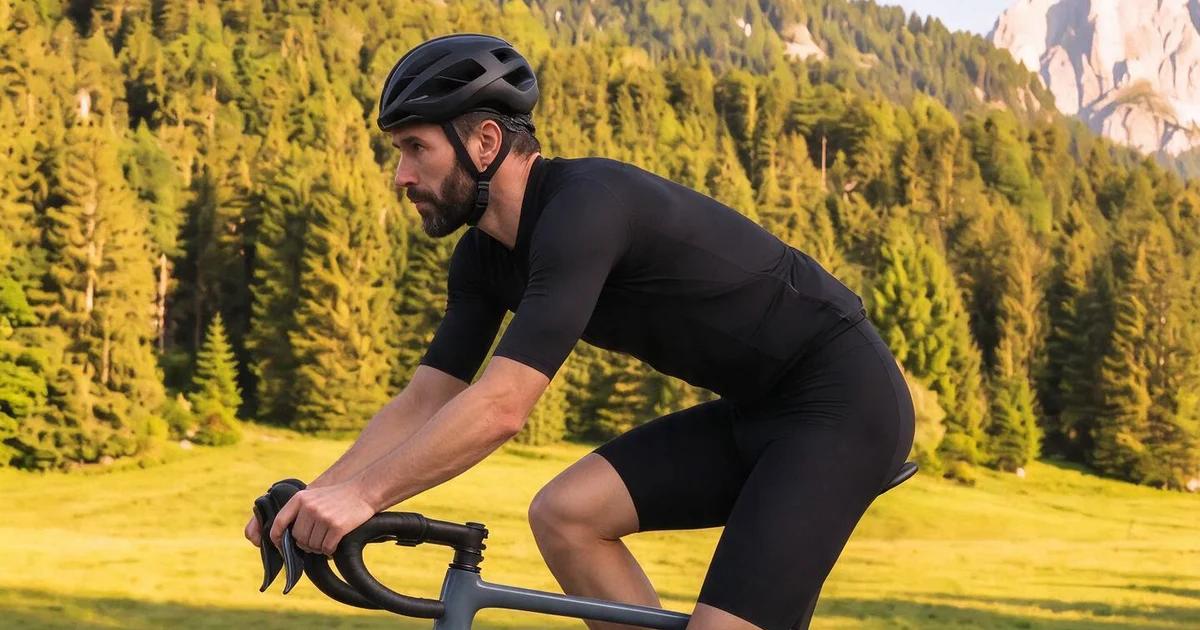
If your lower back hurts on the bike, the first fit suspects are reach and back angle: a bar that is too far away or too low makes you round your lower spine to get to it. The fix for that sits at the cockpit (stem length, spacers, bar height and bar reach), not at the saddle, which is set by your legs.
How a long or low cockpit loads your back
Back angle is how far your torso leans forward from upright. A race position has a flatter back, an endurance or touring position sits more upright, and neither is wrong. Reach is how far forward your hands have to go. The saddle sets where your hips are, and your legs set the saddle, so your torso has to span the gap from hips to hands. If that gap is too long or too low for your flexibility, your body finds the extra distance somewhere: the lower back rounds, the shoulders shrug forward or the elbows lock straight. The same long reach also loads the hands, which is the cause behind numb hands when cycling.
Some lumbar flexion on the bike is normal. In 120 highly trained cyclists, the lumbar spine moved from its standing curve into a flexed (rounded) posture at every hand position, from the tops to the drops. The drops produced the most lumbar flexion and the most forward pelvic tilt of the three1. A systematic review found evidence that riders with lower handlebar heights showed greater lumbosacral flexion while riding2.
Riders with pain flex more. In a field study, cyclists with a specific type of chronic low back pain rode their own bikes outdoors for two hours alongside pain-free riders. The pain group held a more flexed lower lumbar spine throughout, and their pain rose over the ride3. Too much flexion, held for hours, is where trouble tends to start.
What the evidence says about fit and back pain
Lower back pain is common even at the top of the sport. In a survey of 109 professional road cyclists, 58% had experienced lower back pain in the previous 12 months, and 41% of all riders had sought medical attention for it. It caused the most functional impairment and the most medical visits of any overuse problem in that group4.
The 2017 systematic review notes that bike fit is often reported as the risk factor most closely tied to low back pain in cyclists, though its own findings point more to trunk muscle imbalances and spinal flexion2. So fit is a good place to start, but not the only one.
Fixes in order of cost
Change one thing at a time, in steps of a few millimetres, and ride a few times before judging. Note when the ache starts, how bad it is and on which hand position, so you know whether to keep going or step back. Check first that saddle height is right for your knees. If it is off, fix that for your legs before you touch the front end.
- Hand position. Free. If you are fine on the hoods and sore in the drops, ride the hoods more and use the drops when you need them. The drops put your lower back in its most flexed position on the bike1.
- Spacers. If your back rounds hard and the ache builds over the ride, the bar is probably too low. Add one spacer under the stem, or use a stem with more rise.
- Stem. If your arms are locked straight and you feel stretched, the reach is too long. Fit a shorter stem.
- Bar. If your hands creep back to the tops all ride, the hoods are too far or too low: try a shorter-reach bar or rotate the hoods up slightly.
We filmed the three checks for a sore lower back on Instagram. A more relaxed position always works the same way: bring the hands closer and higher through the cockpit.
The saddle is not the fix. It is tempting to slide it forward to "shorten" the bike, or drop it to feel less stretched. Saddle height is set by the legs, from your knee angle at the bottom of the pedal stroke. Moving the saddle to fix your back changes what your knees and hips do on every pedal stroke, and you trade a back problem for a knee problem, as described in knee pain when cycling and saddle height.
Stretching is not the fix either. In a study of 96 highly trained cyclists, hamstring flexibility changed thoracic and pelvic posture during a maximal forward-reach test. On the bike itself, it made no difference to spinal or pelvic posture, and lumbar angles did not differ between groups in any position5. If your flexibility today does not match your position, change the position to fit the body you have, and revisit it if your mobility improves.
Persistent pain, pain that runs down the leg, numbness, tingling, or one side hurting much more than the other are not fit questions. See a doctor or a qualified physiotherapist before you change your bike.
Train the back you ride with
A good position still has to be held, often for hours. The systematic review found that core muscle activation imbalances and back extensor endurance deficits were present in cyclists with low back pain2. Your trunk has to stay stable for the whole ride while your legs work underneath it.
Exercises that ask your trunk muscles to hold a position for time, such as planks, side planks and back extension holds, target this. If you already have pain, a physiotherapist can pick the right ones for you. A position that suits you reduces the load, and better trunk endurance helps you carry the load that remains.
See your back angle on video
The video check reads your back, knee and elbow angles from a side-on clip and compares them with the typical range for the bike, size and riding style you choose. For a sore lower back, the back and elbow angles show whether you are stretched long and low, and the knee angle confirms your saddle height is right before you change anything at the front. You then see which part of the bike to move, the saddle or the bar, and in which direction. A trainer and 15 to 30 seconds are enough; how to film your bike fit video has the full setup.
Your video never leaves your phone; only joint coordinates are sent.
A first check costs nothing and shows whether reach is the problem. The paid fit report adds millimetres and unlimited re-checks after every small stem or spacer change.
Choosing a new bike because the reach felt too long? The bike fit calculator lists 200+ road, gravel and XC models, and the frame-size recommendation is free.
Check your back angle on video
FAQ
Can a bike fit fix lower back pain from cycling?
It can help when the pain comes from your position, which is often the case. Bike fit is often linked to low back pain2, but it is not the only factor. Pain that persists after a fit, or comes with numbness or leg symptoms, needs a medical assessment.
Should I move my saddle forward if my back hurts?
No. Saddle height and position are set by your legs, through the knee angle at the bottom of the stroke. Fix reach and back angle at the cockpit instead, with a shorter stem, more spacers or a different bar.
Is riding in the drops bad for my back?
Not in itself, but the drops put your lower back in its most flexed position on the bike1. Use them when you need them, and if you are sore there, consider a bar with a shallower drop or a slightly higher front end.
Will stretching my hamstrings fix it?
Probably not on its own. In trained cyclists, hamstring flexibility did not change spinal or pelvic posture on the bike5. Fitting the position to your current flexibility and building trunk endurance are better first steps.
Last reviewed: November 2026. Written by the TrainCraft team.
Footnotes
-
Muyor, J. M., López-Miñarro, P. A., & Alacid, F. (2011). Spinal posture of thoracic and lumbar spine and pelvic tilt in highly trained cyclists. Journal of Sports Science and Medicine, 10(2), 355-361. https://pmc.ncbi.nlm.nih.gov/articles/PMC3761866/ ↩ ↩2 ↩3
-
Streisfeld, G. M., et al. (2017). Relationship between body positioning, muscle activity, and spinal kinematics in cyclists with and without low back pain: a systematic review. Sports Health, 9(1), 75-79. https://doi.org/10.1177/1941738116676260 ↩ ↩2 ↩3 ↩4
-
Van Hoof, W., et al. (2012). Comparing lower lumbar kinematics in cyclists with low back pain (flexion pattern) versus asymptomatic controls: field study using a wireless posture monitoring system. Manual Therapy, 17(4), 312-317. https://doi.org/10.1016/j.math.2012.02.012 ↩
-
Clarsen, B., Krosshaug, T., & Bahr, R. (2010). Overuse injuries in professional road cyclists. The American Journal of Sports Medicine, 38(12), 2494-2501. https://doi.org/10.1177/0363546510376816 ↩
-
Muyor, J. M., Alacid, F., & López-Miñarro, P. A. (2011). Influence of hamstring muscles extensibility on spinal curvatures and pelvic tilt in highly trained cyclists. Journal of Human Kinetics, 29, 15-23. https://doi.org/10.2478/v10078-011-0035-8 ↩ ↩2