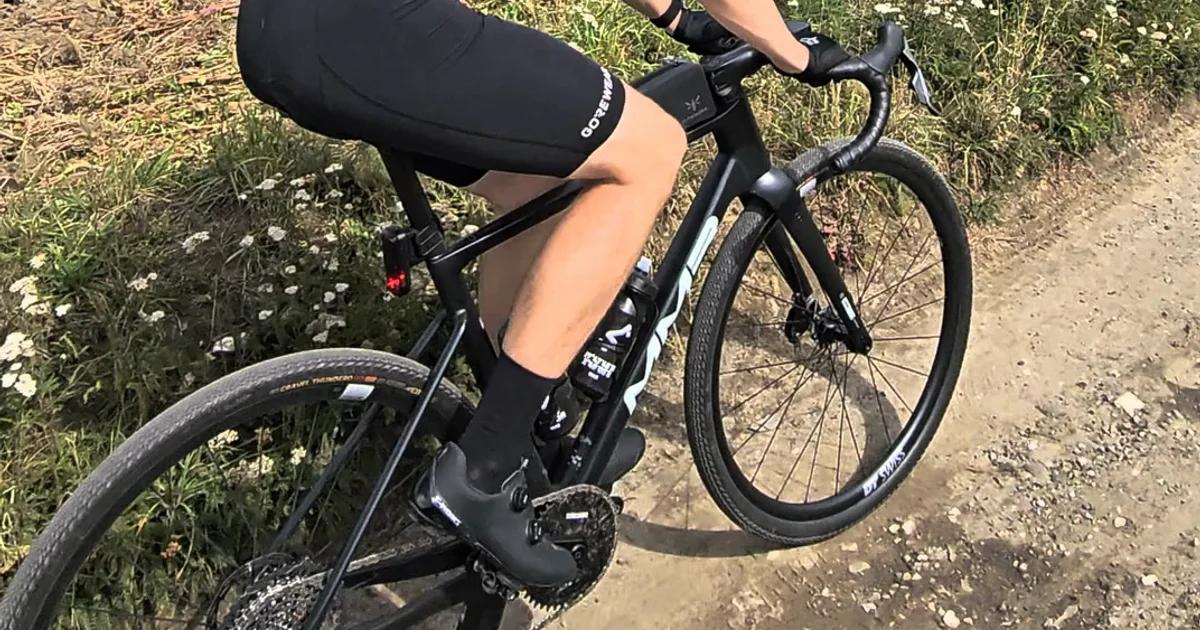
A new bike fit check starts with your old bike: measure saddle height, saddle setback, hand position and cleats on the bike that already works, then copy those points onto the new one. After a few rides, confirm the knee, back and elbow angles on video before you change anything else.
Two frames with the same size label can put your body in different places, because the label says nothing about where the saddle, bars and pedals end up. Stack is the vertical distance from the bottom bracket to the top of the head tube. Reach is the horizontal distance between the same two points. Two size 54 frames from different brands, or two generations of one model, can differ in both. A gravel frame usually sits taller and shorter than a race frame of the same size, and an endurance bike sits taller than an aero bike.
Measure the old bike
Measure the old bike before it leaves the house, and write everything down.
- Saddle height. From the centre of the bottom bracket to the top of the saddle, along the seat tube line, to a fixed point (the middle of the saddle where you sit).
- Saddle setback. Drop a plumb line or use a level from the saddle nose. Measure the horizontal distance from it to the centre of the bottom bracket.
- Saddle tilt. Read the angle with a digital level or a phone app.
- Hand position. Measure from the saddle nose to the centre of the bar tops, and the height difference between saddle top and bar tops (the drop).
- Crank length. It is printed on the inside of the crank arm.
- Cleats. Photograph the soles from below and trace the cleat outlines with a marker.
That is six numbers and two photos, about ten minutes.
Set up the new bike
Saddle height is set by your legs: by the knee angle at the bottom of the pedal stroke. A new frame does not change that angle, so copy the old height to the millimetre. The usual recommendation is a static knee angle of 25 to 35 degrees at the bottom of the stroke1. Inseam formulas do not land there reliably: one common method, 109% of inseam, put riders outside that range 73% of the time1. A review found that a 5% change in saddle height changed knee joint kinematics by 35%2. If your old height already worked, it beats any formula. How to tell if your saddle is too high or too low explains the check.
Setback belongs to your legs too. In one study, moving between forward and backward saddle positions changed knee flexion by 5 to 6 degrees3. Copy the old setback from the bottom bracket, not from the seat post clamp.
Two things can change the number you copy:
- Crank length. Shorter cranks put the pedal higher at the bottom of the stroke, so raise the saddle by the difference. Longer cranks, lower it by the difference.
- Saddle or pedals. A new saddle shape or a pedal system with a different stack height moves your contact points. Measure to where you actually sit, and re-check the knee angle once you have ridden.
If your shoes come with you, leave the cleats alone. With new shoes or a new pedal system, use your photos and outlines to match the cleat's fore-aft position, rotation and side-to-side position. Pedals with a different stack height also change your effective saddle height, so re-check it.
Hand position is where most new-bike mistakes happen. When the new frame has longer reach and you feel stretched, don't slide the saddle forward: that moves your knee over the pedal and undoes the saddle setting. Reach and drop are fixed at the front of the bike, with stem length, stem angle, spacers and the bar's own reach and drop. The table under "After a few rides" lists the fixes.
Say the new frame has 10 mm more reach and 15 mm less stack than the old one. To put your hands back in the same place, start with a stem about 10 mm shorter and about 15 mm more spacer height. Stem angle shifts this a little, so measure the result with the saddle-to-bar numbers from your list. We cover three fit fixes in one ride on Instagram. Check the fork maker's limit on spacer height before you stack them up.
The saddle stays where your legs put it.
Keep the first rides short and easy. A new frame, new tyres and a new bar shape all feel different even when the position is right. Change one thing at a time, a few millimetres per change, and ride a few times before the next one.
After a few rides
Too long means hands far away and a stretched back; too short means cramped elbows. Fix either at the cockpit:
| Difference vs old bike | What it does to you | Fix it with |
|---|---|---|
| Longer reach | Hands further away, more stretched | Shorter stem, or a bar with less reach |
| Shorter reach | Cramped, elbows sharply bent or knees near elbows | Longer stem, or a bar with more reach |
| Lower stack | Hands lower, more drop, more load on back and neck | Add spacers, or a stem with more rise |
| Higher stack | Hands higher, more upright | Remove spacers, or a flatter stem |
Then read where you feel it. In a lab study, a lower saddle (more knee flexion) brought more fatigue and more pain in the front of the thigh and knee, and it made the trunk less comfortable4. The same study found that the measuring convention shifts the number: the comfortable setting read 30 degrees by one convention and about 40 degrees as an absolute angle4. Compare your numbers like for like.
If your knee complains after the swap, read how saddle height relates to knee pain when cycling.
Pain, numbness or a marked difference between your left and right side is not a fit tweak. Stop adjusting and see a qualified bike fitter or a medical professional. A self-check is not a substitute for an in-person assessment.
Confirm on video
Copying numbers gets you close, and video shows whether it worked. The TrainCraft video check compares the knee, back and elbow angles from a short side-on clip with the typical range for the bike, size and riding style you pick. It tells you which part of the bike to move, saddle or bar, and in which direction.
Your video never leaves your phone; only joint coordinates are sent.
The first check is free, so you can see right away how the new bike differs from the position you copied. The paid fit report adds millimetres for the new bike and unlimited re-checks, handy after each small change.
How to film your bike fit video covers the trainer setup. Still choosing between frames? The bike fit calculator holds geometry for 200+ road, gravel and XC models, and the frame-size recommendation is free. Take stack and reach for both frames from the makers' geometry charts.
FAQ
Should I copy my old saddle height exactly to a new bike?
Yes, if the old height was comfortable and you had no knee issues. Measure from the centre of the bottom bracket to the same point on the saddle, and adjust only for a change in crank length, saddle or pedals. Then confirm the knee angle on video after a few rides.
My new bike feels too long. Can I slide the saddle forward?
No. Saddle setback is set by your legs, and moving it changes your knee angle. Fix a long-feeling bike at the cockpit with a shorter stem, a bar with less reach, or by raising the bar with spacers.
Do I need a professional fit for a new bike?
Not always. If your old position was comfortable and you copy it carefully, a self-check is often enough. If you have pain, numbness, an old injury or a clear left-right difference, see a qualified bike fitter in person.
Last reviewed: November 2026. Written by the TrainCraft team.
Footnotes
-
Peveler, W. W., & Green, J. M. (2011). Effects of saddle height on economy and anaerobic power in well-trained cyclists. Journal of Strength and Conditioning Research, 25(3), 629-633. https://doi.org/10.1519/JSC.0b013e3181d09e60 ↩ ↩2
-
Bini, R., Hume, P. A., & Croft, J. L. (2011). Effects of bicycle saddle height on knee injury risk and cycling performance. Sports Medicine, 41(6), 463-476. https://doi.org/10.2165/11588740-000000000-00000 ↩
-
Bini, R. R., Hume, P. A., Lanferdini, F. J., & Vaz, M. A. (2013). Effects of moving forward or backward on the saddle on knee joint forces during cycling. Physical Therapy in Sport, 14(1), 23-27. https://doi.org/10.1016/j.ptsp.2012.02.003 ↩
-
Priego Quesada, J. I., et al. (2017). Effect of bike-fit in the perception of comfort, fatigue and pain. Journal of Sports Sciences, 35(14), 1459-1465. https://doi.org/10.1080/02640414.2016.1215496 ↩ ↩2